


The broader state of the game industry in 2025 reflects both the maturing of AI-enabled development and the lingering aftershocks of earlier waves of consolidation and restructuring. While overall sentiment is more stable than the most turbulent years of the last cycle, many studios still balance caution in new hiring with targeted investment in AI, live-service expertise, and data analytics.
Against that backdrop, events play an important role as neutral ground where teams can compare notes on tools, workflows, career paths, and business strategies shaped by AI and automation. Here’s some of our key game industry event insights and takeaways.
AI’s role in game production is shifting from experimentation to expectation.
Generative tools now sit inside engines and content pipelines, supporting everything from concept art and animation roughs to automated QA test case generation and telemetry analysis on live titles. Many studios treat AI as a multiplier on small and mid-sized teams rather than a one-to-one replacement for traditional roles, which means the most successful projects use AI to clear rote work so developers can focus on design, polish, and player-facing innovation.
At events, this shows up in talks that emphasize practical case studies and guardrails: how to set up review processes, how to control for drift from a game’s creative vision, and how to communicate AI usage transparently to players and partners.
For careers and the job market, 2025 was a year of recalibration rather than unchecked expansion.
Some entry-level and production-heavy tasks have been reduced or re-scoped due to AI, especially where repetitive content or testing is involved, but that shift has opened doors for more specialized roles centered on AI tooling, data, and cross-disciplinary collaboration. Studios increasingly look for developers, artists, designers, and producers who can understand how AI fits into the pipeline, even if they are not building models from scratch, and this expectation is reflected in job descriptions, portfolio reviews, and technical interviews.
According to the Game Developer Conference (GDC) Festival of Gaming GDC 2025 State of the Game Industry Report, about 1/3 of game developers now use GenAI to streamline game development.
Education providers and training programs, in turn, are updating curricula with AI literacy, prompt and workflow design, and ethics in automated content creation, giving new talent clearer pathways to demonstrate readiness for these changing roles.
The geographic footprint of opportunity continues to shift as remote and hybrid work remains common in AI-heavy roles.
Highly specialized engineers, technical artists, and data professionals often work from regions far from traditional game hubs, contributing to global teams that coordinate through digital pipelines shaped by AI-assisted documentation and collaboration tools.
At the same time, on-site events in key cities retain importance for relationship building, recruiting, and showcasing work in progress; studios and vendors use these gatherings to run portfolio reviews, host technical roundtables, and announce AI-focused partnerships or training initiatives.
This blend of remote opportunity with in-person touchpoints underscores why conferences and conventions continue to matter, even in an increasingly virtual world.
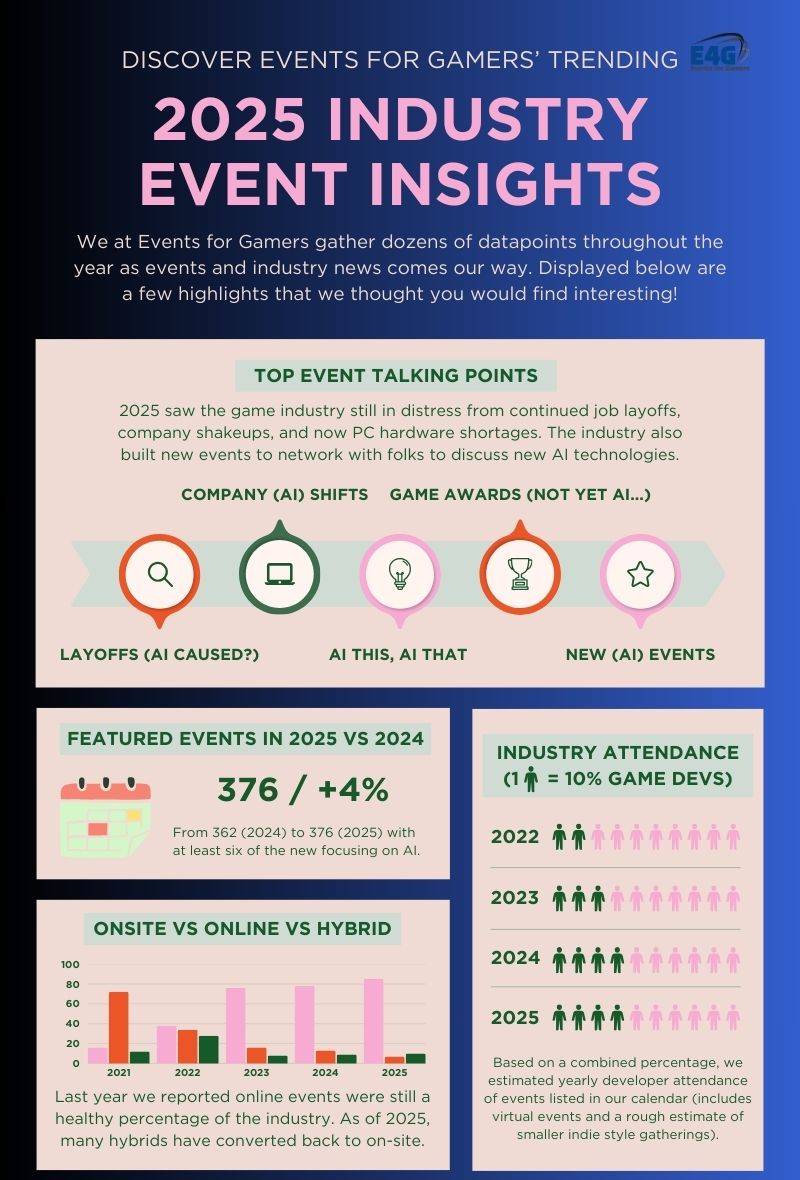
Featured event insights in the infographic:
- Top event talking points
- Number of major events
- Number of onsite vs online vs hybrid events
- Percentage of professionals attending events
- Top voices we recognize
- Top event cities per world region

Looking ahead to 2026, the outlook is cautiously optimistic, particularly for professionals who can pair solid fundamentals in game development with an understanding of AI and data-driven design. Analysts and labor reports point to continued demand for AI engineers, gameplay programmers with AI integration experience, data scientists, and hybrid roles such as AI-aware game designers and product managers.
As more studios move from pilot projects to fully productized AI workflows, there is likely to be a premium on teams that can show measurable results, such as shorter production cycles, better live-ops performance, or more personalized player experiences.
For events, that means 2026 will likely bring even more sessions devoted to AI ethics, retraining and upskilling, and case studies that map directly to career development, helping professionals navigate a market where AI is no longer optional but a core part of how games are imagined, built, and sustained.
As we’ve been hearing, it’s all AI, AI, AI from here…
As 2026 kicks into high gear, look towards our industry event calendar for networking events to attend. We are here for your game idustry event and (event insights) needs!
Author: Mathew Anderson, CEO and Editor-in-Chief of Events for Gamers, Community Manager for the computer game industry, and Public Relations Manager and Communication Specialist for various other industries.