


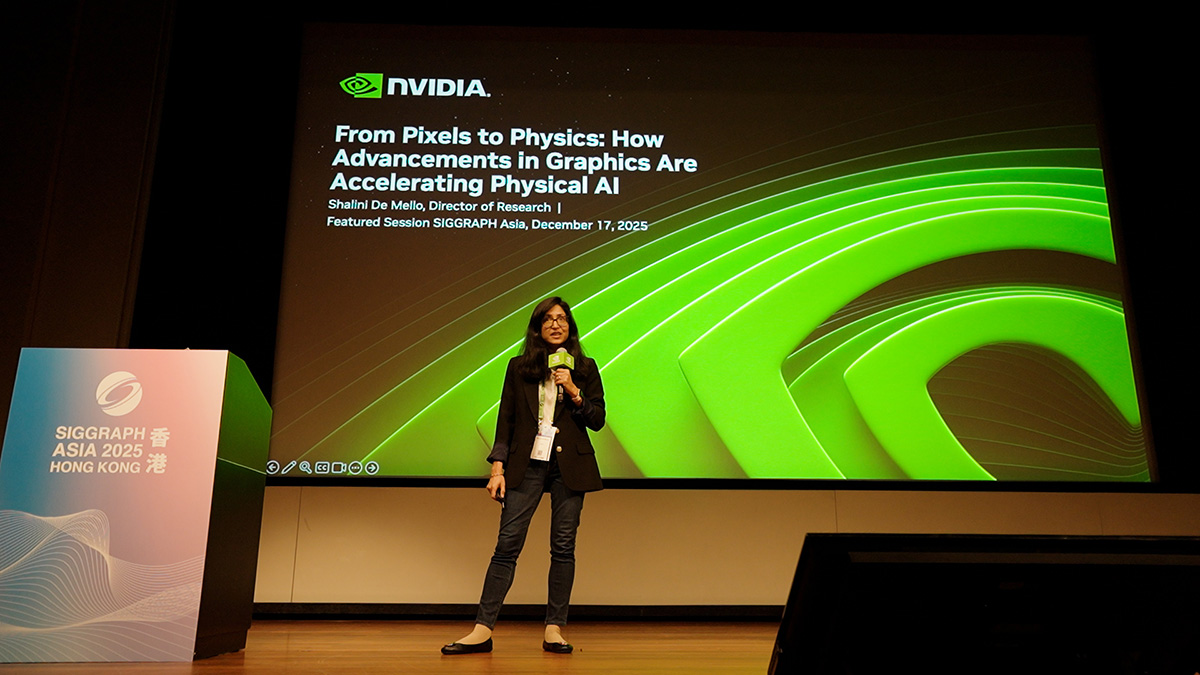
If you’ve ever been wowed by a game’s lighting, a film’s visual effects, or a real-time demo that made you wonder how it was even possible, there’s a good chance the ideas behind it were shared at a SIGGRAPH event. SIGGRAPH Asia is the Asia edition of that family of conferences, a yearly gathering for computer graphics and interactive techniques that brings researchers, artists, developers, and industry professionals together through technical papers, courses, exhibitions, and more.
With the 2026 edition on the horizon, we wanted to dig into what’s changing. SIGGRAPH 2026 in Los Angeles is launching a dedicated Games Summit, and AI, real-time graphics, and immersive technology are reshaping how games and interactive experiences get made. That got us curious about what it all means for SIGGRAPH Asia, and for the game developers, studios, and fans across the Asia-Pacific region who are driving that innovation.
So we sat down with Carrie de Souza, Project Director of SIGGRAPH Asia, who has been part of the conference since 2014. Carrie shared thoughts with us on how the event has grown, its 2026 theme “Weaving the Future,” and what game developers and graphics professionals can look forward to.
We hope you enjoy the conversation as much as we did.
Events for Gamers (E4G): Before we dive into 2026 specifics, could you share your personal history with SIGGRAPH Asia? What drew you to this role, and how has your perspective on the conference’s mission evolved since you first engaged with the computer graphics community?
Carrie de Souza: “I’ve been with SIGGRAPH Asia since 2014, so it’s been a big part of my career for quite a long time now.
What initially attracted me to the role was the mix of technology, creativity and innovation. And over the years, what I’ve really come to appreciate is the community, you have researchers, artists, technologists and industry professionals all coming together from different parts of the world.
When I first started, I probably thought of SIGGRAPH Asia mainly as a conference that we had to deliver each year. But over time, I’ve come to see it much more as a platform for the community, a place where people can meet, exchange ideas, and see what’s coming next.
The technology keeps changing, but that fundamental role of bringing people together is what I think makes SIGGRAPH Asia so valuable, and it’s also what has kept me involved for so many years.”

E4G: SIGGRAPH Asia has evolved significantly over the past decade. As you look ahead to the 2026 edition, what are the primary market shifts in computer graphics and interactive technologies that are reshaping how you position the conference for attendees, exhibitors, and the broader APAC region?
Carrie de Souza: “I think the biggest shift is that computer graphics is no longer a niche technology conversation. It’s becoming much more integrated into industries like entertainment, gaming, advertising, design, manufacturing, education and, increasingly, AI.
For 2026, AI is obviously a major part of that conversation, but I think it’s important that we look beyond AI on its own. We’re seeing rapid developments in real-time graphics, virtual production, digital humans, immersive experiences and new creative workflows.
From a positioning perspective, that means SIGGRAPH Asia has to appeal to a much broader audience while still maintaining the depth and credibility that the traditional SIGGRAPH community expects. For exhibitors, it’s about showing how these technologies are being applied in the real world, and for attendees, it’s about understanding not just what the technology can do, but where it is heading next.
For APAC in particular, I think there’s a huge opportunity because the region has such a diverse and fast-growing technology and creative ecosystem. SIGGRAPH Asia can play an important role in connecting those communities and giving the region a platform to showcase what is being developed here, while also bringing the global community into Asia.”
E4G: Asia-Pacific markets represent some of the fastest-growing sectors in gaming and real-time graphics. What specific initiatives are you implementing to ensure SIGGRAPH Asia 2026 reflects regional innovation hubs, such as, for example, Southeast Asian mobile development, Japanese console expertise, or Chinese metaverse infrastructure?

Carrie de Souza: “One of our priorities for 2026 is making sure SIGGRAPH Asia feels genuinely connected to the region, rather than simply bringing an international programme into Asia.
We’re looking at the different strengths across APAC and making sure those perspectives are represented through our programme, speakers, exhibitors and industry engagement. That could mean looking at areas such as Southeast Asia’s growing games and mobile ecosystem, Japan’s long history in games and animation, or the rapid development of AI, virtual worlds and real-time technologies across China and other markets.
We also want to create more opportunities for regional companies and studios to showcase what they’re actually building and bring those conversations to an international audience.
For me, the opportunity with SIGGRAPH Asia is really about connecting the dots, bringing together the different innovation hubs across APAC, while also connecting them with the global SIGGRAPH community. That regional exchange is a big part of what we want the 2026 edition to deliver.”
E4G: With SIGGRAPH 2026 in Los Angeles launching a dedicated Games Summit, how does SIGGRAPH Asia plan to elevate its gaming content for 2026? Are we seeing a fundamental shift in how the conference treats interactive entertainment relative to traditional VFX and animation segments?
Carrie de Souza: “Gaming is a major focus for us in 2026, and we see a real opportunity to elevate it within SIGGRAPH Asia. But this isn’t about moving away from our strong foundations in VFX and animation, it’s about recognising how closely these fields are now connected.
Game development, animation, VFX, virtual production and real-time graphics are increasingly sharing the same technologies, tools and creative workflows. So for us, it makes sense to bring these communities closer together.
For 2026, we want to give gaming and interactive entertainment a stronger presence through the programme, industry participation and opportunities for studios and technology companies to showcase their work.
And being in Asia is particularly relevant. We have such a strong gaming and interactive entertainment ecosystem across the region, so SIGGRAPH Asia is in a good position to connect that regional expertise with the broader global graphics community.
So I see it less as a fundamental shift and more as SIGGRAPH Asia reflecting how the industry itself is evolving the boundaries between games, VFX, animation and real-time experiences are becoming much less defined.”